


Summary
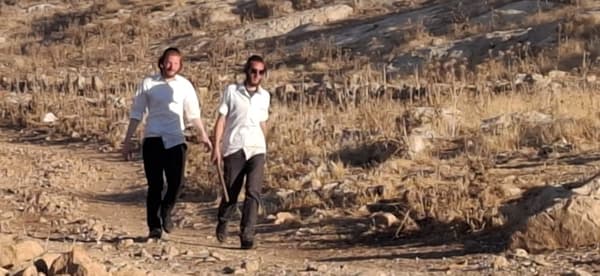
Israel in 2026 does not refrain from using minors as part of its moves toward ethnic cleansing in Area C of the occupied West Bank. This occurred on the outskirts of Fasayil in the southern Jordan Valley, where activists from “Looking the Occupation in the Eye” maintain a protective presence around the home of Abd, who suffers daily harassment from a small outpost established opposite his home. A minor from the outpost claimed that Abd’s 14-year-old son threw a stone at him. There is no proof, but the allegation alone was enough to bring a large military force to the site. The boy was arrested and taken to an IDF base where soldiers beat him before releasing him.
Amir Panski described it this way:
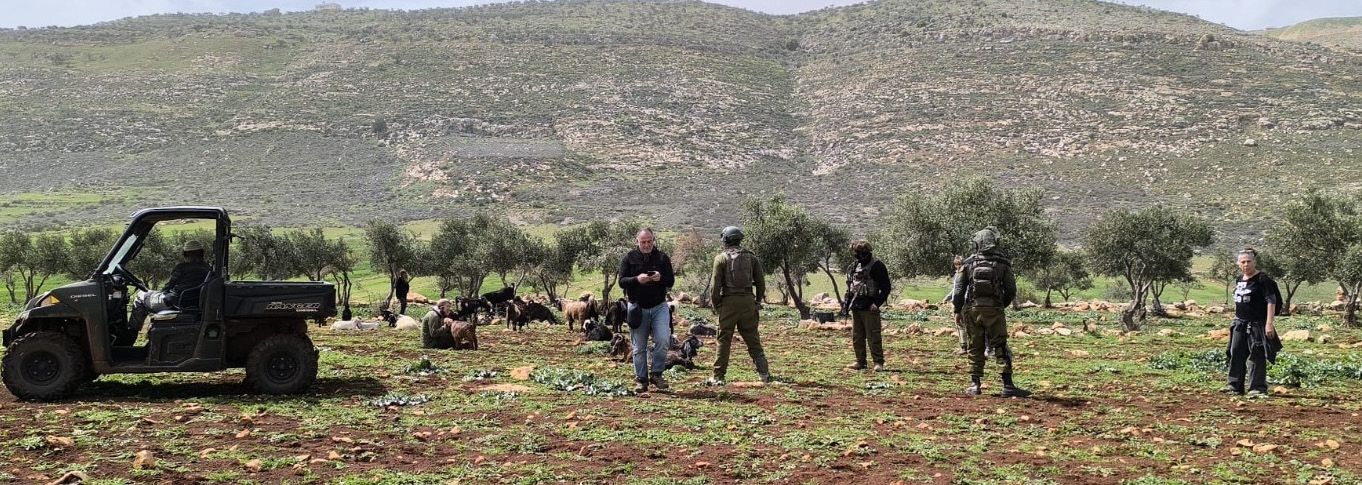
“Settlers cut water pipes, cut electricity cables, enter the home of a Palestinian family with and without herds. There is no army, no police. Then a settler comes, invades the same house and claims that a child threw a stone at him—and the entire Jordan Valley Brigade shows up.”
Roy Talmon added:
“They took a child / the age of my son / today in Fasayil. / They handcuffed his hands / with a black plastic zip tie / too tight. / Put him in a military vehicle on false pretenses. / And when he was alone / far from his family / out of the cameras’ sight / they beat him. / Terrified him. / Imposed terror. / And then released him. / The routine of occupation.”
“Looking” activists also maintain a protective presence in Khirbet a-Tawil on the outskirts of Aqraba, where harassment by settlers is daily. This effort needs volunteers.
________________________________________
Sunday
Eleven families in Khirbet Yarza in the northern Jordan Valley were expelled from their land over the weekend. The expulsion was part of a project to dig a section of the eastern security barrier along 22 km. Excavation began after mines in the area were cleared. During the work in the Tamun Valley water lines were destroyed, landowners east of the trench were cut off from their farmland, and residents were forbidden to cross the trench even on foot.
The barrier segment in the Tamun Valley is part of a plan to establish a 500-km security barrier along Israel’s eastern border. In the Jordan Valley of the occupied West Bank it also carries political significance, since its construction is accompanied by ethnic cleansing and the de facto annexation of land between the barrier and the border with the Kingdom of Jordan. In the Tamun Valley the barrier is being built about 12 km west of the Jordan River (not on the international border), a move that will disconnect Palestinians from tens of thousands of dunams of grazing land and open areas they have long used in the valley.
In this context it was reported that the Jordan Valley Brigade commander, Col. Gilad Shriki, visited five communities in the northern Jordan Valley on Friday, March 8, 2026. During the visit he told residents they would have to leave because a fence would soon be built that would make it difficult for them to live there.
Monday
Unusually large forces of the army and police arrived in Fasayil at Abd’s home due to the fabricated complaint that Abd’s 14-year-old son—who had been grazing the family’s sheep—threw a stone at a settler. Settlers also blocked the road to prevent Palestinian vehicles from passing. The boy was taken by the army and at a base behind the fences soldiers beat him and then released him. “Looking” activists were present and followed the vehicle that took the boy away. In addition, Abd received a demolition order for his home to be carried out within a week. As is customary, the order instructs him to demolish it himself; otherwise the Civil Administration will do so and charge him the costs.
Tuesday
Police released the three detainees suspected of attacking “Looking the Occupation in the Eye” activists in the village of Qusra on Friday, February 27, 2026. Police did not request an extension of their detention. The attackers had been masked, and because elementary investigative steps were not taken, the police could not link the three detainees to the masked assailants who beat the volunteers with clubs and iron rods. The three injured activists were evacuated for medical treatment and released from hospital during the week. Both the President of Israel and the army condemned the attack, but—as in the overwhelming majority of such incidents—the cases are expected to be closed without anyone being held accountable.
The organization “Looking the Occupation in the Eye” said:
“Under cover of the war, Jewish terror is escalating, and under the cover of the police’s deliberate weakness it is also receiving encouragement and a pat on the back. This weakness is not a mistake—it is deliberate policy, and the blood of the wounded is on the hands of the government ministers and its leader.”
Wednesday
Due to settler violence, members of the Kaabneh families left their home on the outskirts of Duma after the army issued a closed military zone order that removed the protective-presence activists. Reports today also indicate that the neighboring community of Mu‘arajam is under a combined assault: at night the army raided homes, arrested the family’s grandfather, and beat others including women and children. During the day the army prevented activists from reaching the village—which is not a closed military zone—while settlers continued their attacks on the community.
Thursday
During the night between Thursday and Friday, more than 30 settlers armed with clubs attacked the compound of the Abu al-Kabash family in Humsah in the northern Jordan Valley. The attackers smashed the security cameras, gathered the residents into a tent, tied them up, and beat them. Four men and two international volunteers were injured and taken to hospital. One of the men was sexually assaulted. A herd of 350 sheep was stolen and loaded onto the attackers’ vehicles. The army and police arrived two hours later. According to reports, the settlers drove toward the nearby settlement of Beka’ot after the attack. Police said an investigation had been opened.
Friday
Settlers attacked in Deir Istiya. Members of the protective presence, including Aviv Tatarsky, called the police in vain. The attackers threw stones and sprayed one of the Palestinian farmers with pepper spray. Tatarsky called the police again, and soldiers and Border Police arrived—but ordered Tatarsky and another activist to leave, allowing the attackers to assault residents. One of the assailants attacked Tatarsky in front of an officer who was present.
Saturday
In the village of Qusra, where “Looking” activists had been beaten two weeks earlier, settlers carried out another attack on Palestinian residents. Amir Mu‘tasem Ouda was shot and killed, and three other residents were wounded, including his father.
After dark, an undercover unit (soldiers in a vehicle with Palestinian license plates) entered the town of Tamun, south of Tubas. A car carrying a family returning from shopping in Nablus approached them. The soldiers fired bursts of gunfire at the vehicle. Ali Bani Ouda, his wife Widad, and two of their children—Uthman and Muhammad—were killed. Two other children, aged eight and eleven, were lightly wounded. The eldest surviving child said that a soldier who pulled them from the car told his comrades, “We killed dogs,” and then beat him.
The response published by the Defense Forces was: “The car accelerated toward the forces, who felt threatened. The Military Police have opened an investigation into the incident.” The question remains: what driver, with four children and his wife in the car, would accelerate inside his own village toward a vehicle that appeared to be Palestinian?