Weekly Review
April 12–18, 2026

Weekly Review
April 12–18, 2026
Weekly Review
April 12–18, 2026
Weekly Review
April 12–18, 2026
Weekly Review
April 12–18, 2026
Weekly Review
April 12–18, 2026


Summary
A few days before Israeli Independence Day, Benjamin Netanyahu was once again forced to back down in the face of President Trump’s demands. The decision on a ceasefire in the Lebanese arena—allowing residents of northern Israel at least a few days of calm—was made in Washington and Tehran, and imposed on Israel’s prime minister, who merely informed the security cabinet. The Ayatollah regime, which the U.S. president was misled into believing would be removed within days, survived the joint Israeli-American attack and demanded, as a condition for continuing talks, a ceasefire with Hezbollah and Lebanon. The boastful Netanyahu speeches of previous weeks gave way to an announcement that the mission had not been completed.
A relatively quiet weekend passed for residents within Israel’s 1967 borders, but there is no real calm. After forcing Netanyahu into a ceasefire, Trump warned: “If no agreement with Iran is signed by Wednesday, I may not extend the ceasefire.” While there is relative quiet in the Galilee, settler actions continue in the West Bank with the aim of advancing ethnic cleansing—through violent incursions and arson in Palestinian communities, as well as attempts to push shepherding communities off their land and homes. Opposing them are human rights activists, including members of “Looking the Occupation in the Eye,” who maintain a protective presence.
The escalation of terror acts in the West Bank has penetrated the media, leading to a response among right-wing settler spokespeople. However, those condemning the violence of the “hilltop youth” are not concerned with human rights; they are worried about the future of the settlement enterprise they continue to support. This racist project has been based on an ideology of Jewish supremacy, leading to the dispossession of Palestinians from their land for the sake of “Greater Israel.” They do not acknowledge that the armed rioters emerging from outposts are supported by the army, receive tens of millions of shekels in state funding, and enjoy backing from regional council leaders.
Since the settlement enterprise is also supported by major opposition parties, Israeli settler terrorism—alongside the endless war—will only be halted through international pressure. Signs of this were evident this week: Trump’s disregard for Netanyahu; Pope Leo XIV, who does not hesitate to confront the U.S. president, marking another goal—“to stop settler violence”; the U.S. Senate vote on supplying bulldozers and bombs to Israel; and the freezing of the security agreement with Italy by its prime minister. These are early signs of a potential shift.
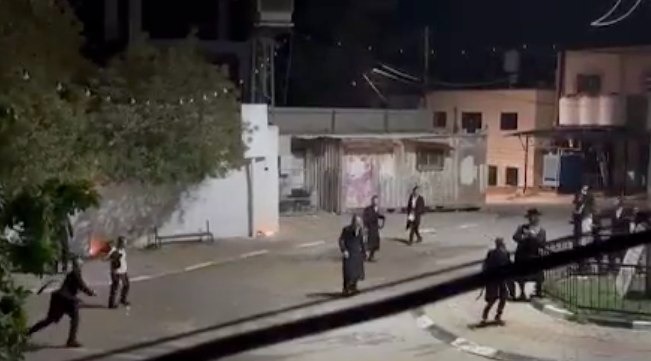
Sunday – Hundreds of ultra-Orthodox Jews entered the village of Kifl Haris at night, near the “Tomb of Joshua bin Nun,” to mark his anniversary of death. The intruders threw stones at Palestinian homes. To secure such visits, security forces take over the village, placing residents under curfew from afternoon to evening. Last year, they were even forbidden from looking out their windows. "mistaclim" helped install protective netting on village windows to prevent damage.
Monday – Settlers established a small outpost above a local family’s home in Khirbet a-Tawil, erecting a fence and bringing water—likely to keep goats there. Harassment by outpost youth continued throughout the day and evening. The local family abandoned their home and moved with their flock to another location.
Soldiers were documented in the morning firing tear gas at students attempting to reach school in Umm al-Khair in the South Hebron Hills. Earlier, Palestinians reported settlers blocking the road with Israeli flags and barbed wire. The IDF stated that forces used riot dispersal measures due to a gathering of Palestinians and that there were no injuries.
Tuesday – Master Sergeant (res.) Eyal Uriel Bianco, 30, was killed in southern Lebanon.
Wednesday – A reservist soldier was arrested on suspicion of shooting and killing a Palestinian and wounding others in the village of Qusra near Nablus last month. The suspect, a settler serving in regional defense, allegedly acted outside his official duties. His detention was extended, and his weapon confiscated. Another investigation was opened into a reservist who shot and killed a Palestinian in Deir Jarir near Ramallah. Since early March, nine Palestinians have reportedly been shot dead during settler incursions.
This pattern repeats: settlers enter a village, initiate violence, and when residents respond—sometimes by throwing stones to drive them away—settlers open live fire “in self-defense.”
Forty settlers attacked a house in Jifna, a Christian village north of Ramallah, stealing livestock. A Palestinian was arrested.
Activists in Ein al-Hilweh in the northern Jordan Valley were attacked by settlers on an ATV; both activists and local residents were reportedly sprayed with pepper spray.
Thursday – In an article titled “It Looks Like Blue-and-White Ethnic Cleansing,” Ron Ben-Yishai, a Veteran and renowned journalist described in Yediot Ahronot newspaper, a tour of the West Bank, writing that what they saw was deeply disturbing, pointing to organized, systematic, and funded actions aimed at removing Palestinian presence and annexing the territory.
A protest against the occupation took place at Habima Square in Tel Aviv, organized by human rights groups, with around 1,000 demonstrators and a heavy police presence.
Friday – Senior NCO (res.) Barak Kalfon, 48, was killed by an explosive device in southern Lebanon; two other soldiers were moderately wounded.
In Masafer Yatta, two vehicles were set on fire overnight; footage showed an armed settler guarding those committing the arson.
Masked settlers raided the village of Asira al-Qibliya near Yitzhar settlement , setting fire to a car and a structure. Video footage shows individuals carrying Molotov cocktails, igniting property, and fleeing.
Saturday – Staff Sergeant (res.) Lidor Porat, 31, was killed by an explosive device in southern Lebanon; nine soldiers were wounded, one seriously. Fifteen soldiers have been killed in southern Lebanon during the current war.
Harassment by settlers from a nearby outpost near Khirbet a-Tawil continued throughout the day, with threats directed at residents to leave their homes or risk having their herds taken.


