Weekly Review –
March 29 – April 4, 2026

Weekly Review –
March 29 – April 4, 2026
Weekly Review –
March 29 – April 4, 2026
Weekly Review –
March 29 – April 4, 2026
Weekly Review –
March 29 – April 4, 2026
Weekly Review –
March 29 – April 4, 2026


Summary
Incidents between Palestinians and settlers, often supported by security forces and rarely broadcast on television, are a daily occurrence. In many cases, armed settlers or reservist settlers recruited into regional defense units are responsible. They reside in both legal and illegal outposts and are armed with IDF-issued weapons. This was the case at the beginning of the month when two brothers, aged 48 and 52, were shot dead by a reservist soldier in the village of Qaryut, south of Nablus. This week, multiple reports indicated that settlers who invaded Palestinian villages and compounds opened live fire. This phenomenon is intensifying week by week. Haaretz reported that the army acknowledges that in many cases, weapons used in violent incidents against Palestinians are IDF-issued.
The Chief of Staff ordered the Central Command commander to investigate the Tayasir incident. Yaniv Kubovich reported in Haaretz that Rabbi Elyakim Levanon described a conversation with Central Command head Avi Bluth, in which the rabbi claimed doubts were raised regarding the enforcement of evacuation orders by the IDF. “An evacuation order has no real meaning,” said Levanon, adding that Bluth “laughed” when asked about enforcement. According to Levanon, Bluth said that unless he gives explicit orders, no evacuation will be carried out. The IDF Spokesperson confirmed the conversation took place but denied the rabbi’s claims. It was also reported that in many cases, enforcement against Jews who attack Palestinians is avoided due to political and social pressure on senior military command.
Activists from “Looking the Occupation in the Eye” continue to maintain a protective presence in Khirbet a-Tawil and al-Auja.
Sunday – Sgt. Liran Ben Zion, 19, from Holon, was killed by anti-tank fire in southern Lebanon. Four additional soldiers were seriously wounded in the northern sector.
Monday – A Palestinian man, Ramzi Abd al-Hakim Muhammad al-Awawdeh, 22, was shot dead overnight by IDF soldiers in the town of Harsa, south of Hebron. According to the Palestinian news agency WAFA, the IDF prevented Palestinian ambulance teams from reaching the wounded man until he died.
The IDF suspended from operational activity the reserve battalion whose soldiers attacked a CNN crew near Tayasir. One soldier will be dismissed. Knesset Foreign Affairs and Defense Committee Chairman Boaz Bismuth criticized the Chief of Staff over the decision. “The battalion will remain in reserve service and undergo a process to strengthen its professional and ethical foundations,” the IDF Spokesperson stated.
IDF bulldozers uprooted olive trees in Deir Istiya along Road 5066. At least 200 trees, some centuries old, are expected to be uprooted under an order issued by the Central Command commander for “security needs.” This is the second time in recent months that the IDF has uprooted olive groves in the village. Over the past year, groves in the neighboring villages of Haris and Kifl Haris were also uprooted.
Tuesday – Four soldiers from the Nahal Reconnaissance Unit were killed in southern Lebanon: Capt. Noam Madmoni, 22, a team commander from Sderot; Staff Sgt. Ben Cohen, 21, from Lehavim; Staff Sgt. Maxim Antis, 21, from Bat Yam; and Staff Sgt. Gilad Harel, 21, from Modiin. They were killed in an encounter with Hezbollah fighters. Three additional soldiers were wounded.
Masked settlers raided the village of Tayasir, where the CNN crew had been attacked the previous week. Four Palestinians were injured and evacuated to hospital. The attackers also set fire to buildings, vehicles, and a tractor.
Settlers set fire to cars and sprayed graffiti in the village of Nahalin near Bethlehem and on the outskirts of the town of Samu near Hebron. Another Palestinian vehicle was torched by settlers in Khirbet Abu Falah near Ramallah.
Wednesday – The Israeli-Palestinian Bereaved Families Forum was nominated for the 2026 Nobel Peace Prize. The nomination stated that the forum “demonstrates that the true moral choice is between those committed to shared humanity and those who perpetuate violence. Awarding the Nobel Prize to the forum would catalyze change—amplifying the voices of civil communities that currently lack visibility and shifting global attention toward reconciliation rather than one-sided support.”
Saturday – Staff Sgt. Guy Loder, 21, a soldier in the Maglan unit, was accidentally killed by IDF fire in southern Lebanon. His death brought the number of soldiers killed in southern Lebanon in the current round of fighting to 11.
Settlers raided the village of Jalud, set homes on fire, and fired toward residents. The town of Qusra was also attacked overnight by settlers. Live fire was used, poultry coops were set ablaze, and a local resident was abducted and later dumped in a field in serious condition.
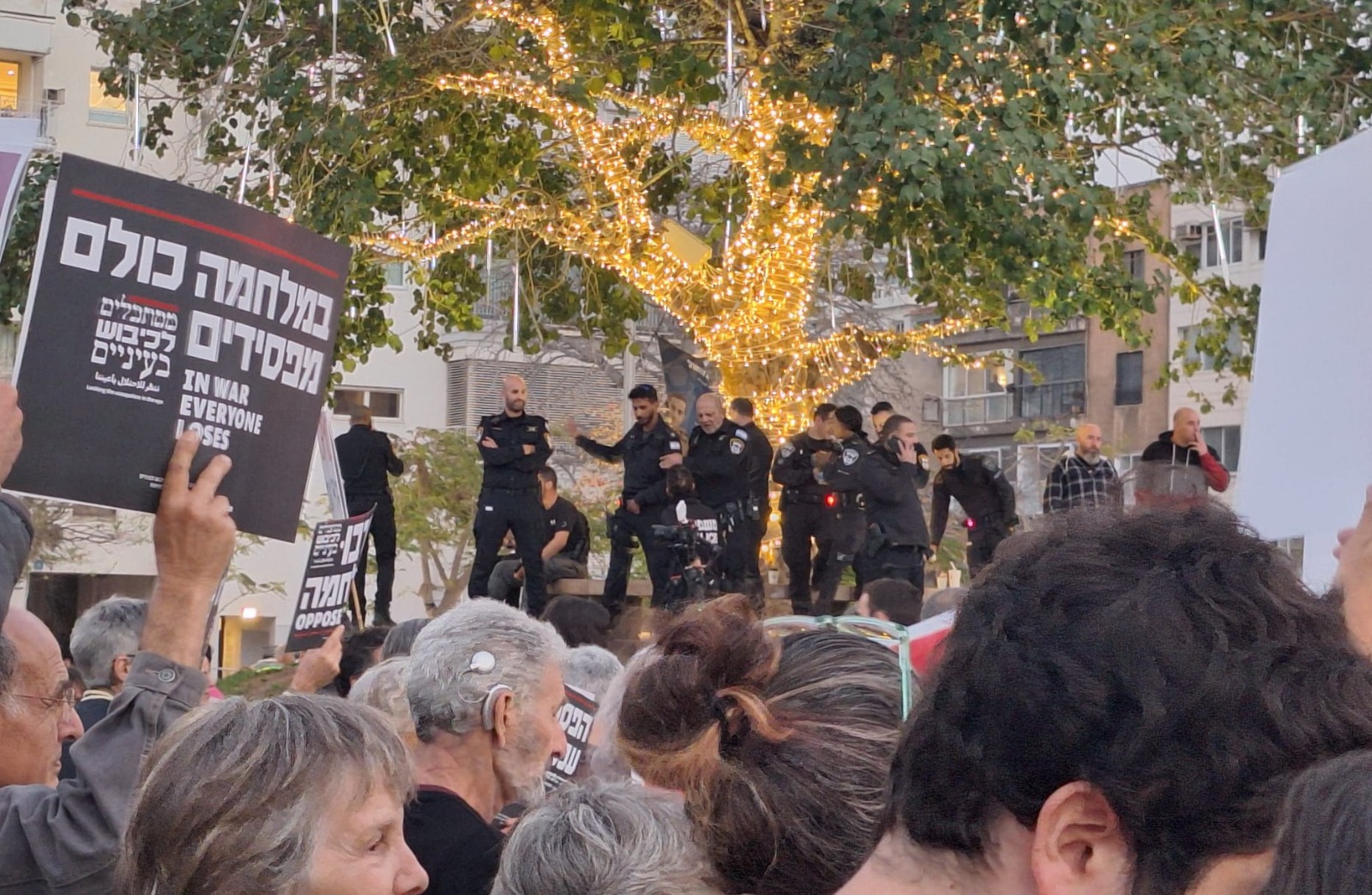
More than 1,000 demonstrators gathered Saturday night at Habima Square in Tel Aviv. Dozens of police officers awaited them. The Home Front Command announced it would not approve a protest of 1,000 people in the square, and the High Court of Justice ordered that at least 600 demonstrators be allowed to participate. Police took control of the “protest hill” overlooking the square, and after about half an hour, officers—accompanied by mounted units—began attempting to disperse the demonstrators using force. During this time, an alert signal and then a siren were heard. Protesters moved to a protected parking area, and multiple testimonies stated that police forcibly pushed people into the shelter, which can hold many hundreds, and refused to allow detained protesters to enter the protected space.
One protester suffered cardiac arrest, and a resuscitation team including Prof. Kobi Sheham, head of the cardiac intensive care unit at Ichilov Hospital, treated him in the shelter. Dr. Udi Beharb, who participated in the resuscitation, was pushed aside by a police officer who identified himself as a doctor. Prof. Hagai Levine, chairman of the Public Health Physicians Association of the Israel Medical Association, responded on X: “Tonight all boundaries were crossed. A police officer interfered with a doctor performing resuscitation in the protected space beneath Habima and prevented him from trying to save a life!! Ben-Gvir’s police endangers public health. An investigation by the Police Internal Investigations Department must be opened against this officer.” Magen David Adom (Israel’s national emergency medical service) reported that the protester’s heart resumed beating and he was evacuated to hospital in serious but stable condition.
In its ruling, the High Court noted that Home Front Command guidelines were not enforced at other gatherings, stating: “This means that police enforcement of Home Front Command guidelines is carried out against protest demonstrations, but not against other places and events. This situation is difficult to accept.” Following the ruling, police stated that they allowed a protest of 600 participants only, but that demonstrators were violating the guidelines, and they were working to disperse them. Seventeen protesters were arrested and later released. Demonstrations also took place at additional locations around the country, with about 300 participants each in Jerusalem and Haifa.


