"Protective presence"
ahead of the elections

"Protective presence"
ahead of the elections
"Protective presence"
ahead of the elections
"Protective presence"
ahead of the elections
"Protective presence"
ahead of the elections
"Protective presence"
ahead of the elections


After two years of harassment, the community of Ras Ein al-Auja finally gave in and last week definitively abandoned its land in the southern Jordan Valley. The community, numbering about 120 families and serving as a symbol of steadfast resistance to ethnic cleansing in Area C, accompanied by a close “protective presence” of “Looking the Occupation in the Eye,” is no more. On the tin shacks left behind, the words were spray-painted: “Third Nakba 2026.”
An outpost established just dozens of meters from residents’ homes was the straw that broke their backs. For many months they were denied access to water and pasture; Palestinian herds were confined to their pens while settlers’ herds from illegal outposts roamed among the tin structures of the shepherd families, who were threatened by outpost youths and their handlers. The IDF stood by the settlers. The police, if they arrived at all, did so late—and when they did arrive, at best they told residents and activists to “file a complaint,” and at worst they arrested or detained them—the victims.
As long as this happened beyond the Green Line, the media preferred to ignore it. Only when Sigal Shukron was attacked with her family earlier last week in her home in Kibbutz Glil-Yam did television channels and newspapers wake up, realizing there was a “story that could sell.” The media and much of Israel’s “democracy-loving” public must awaken and act in the face of a phenomenon we came to know in the first half of the 20th century in Italy and Germany; otherwise our fragile democracy (which for now applies to Jews only) will soon raise a white flag.
The erosion of Israeli democracy did not begin in 2026, but it is gaining momentum without real resistance. During one of the earlier election campaigns my partner and I volunteered as poll observers on behalf of one of the “defenders of democracy” organizations. We chose to spend a day at two polling stations in Beitar Illit, since turnout in ultra-Orthodox communities is known to reach 100%, and it was important to ensure it did not exceed that. The summary of Election Day at the polling stations where we sat was that the atmosphere was pleasant, voting was well organized, and no irregularities were recorded. It is possible our presence contributed to this.
The discourse ahead of the 2026 elections—if they indeed take place, sometime between May and October (the statutory date is 27.10)—focuses quite a bit on threats to their integrity. Concern about the fairness of the electoral process may, among other things, undermine public trust in vote counting and in the reliability of the final results, a situation that could deter many from going to the polls. There may also be a scenario in which party leaders who lose power challenge the results afterward, potentially leading to an Israeli version reminiscent of the 2021 attack on the Capitol.
The 2026 election campaign is the last opportunity to return the state to a democratic and egalitarian path—an opportunity that will not return—to replace at the ballot box the rule of a criminal organization led by Bibist Likud. Likud understands very well that its chances at the ballot box are slim; therefore, its members will do everything in their power to prevent defeat before the elections, during them, and possibly afterward.
Experts have identified several dangers to free elections, foremost among them legislation that would prevent fair elections and equal opportunity for all competing parties—up to and including disqualification and barring some from running by the Central Elections Committee and the High Court in its new guise. Additional dangers exist: restrictions on freedom of expression and press freedom; the creation of an artificial state of emergency that would prevent free elections and preclude participation in the electoral process by certain segments of the public among candidates and eligible voters; threats against candidates and lists that would cause them to withdraw; foreign interference and cyberattacks; the use of artificial intelligence (AI) and disinformation during the campaign (“the Arabs are flocking to the polls”).
It would not be surprising if the government manufactures an ongoing security situation that serves as a pretext to curtail civil rights and liberties. We have witnessed this since October 7, 2023. In the name of state security, opponents of the government are incited against; any opposition is portrayed as subversion; they are branded with the stamp of “treason,” and then protest is restricted and criticism silenced. This often happens institutionally, by Ben-Gvir’s police (sometimes with assistance from the Shin Bet and certain judges), and at other times by funded organizations (“Im Tirtzu”) and/or individuals acting on their own, sometimes aided or indirectly funded by branches of ruling parties.
Democracy advocates in general—and we who struggle against the occupation in particular—can and must prepare in advance to fight for fair elections. The struggle must take place both in the months leading up to them and on Election Day. But even before we mobilize for this campaign, an additional step is required to encourage 20% of eligible voters to exercise their right on Election Day. They will do so when they feel their vote will have an impact on the election outcome. This can happen, and the first step has been taken with the announcement of the re-establishment of the Joint Arab List. Polls confirm the possibility of increased Arab representation in the Knesset. The fingers of the Joint List’s representatives may determine what the government looks like after the elections.
As a first step to encourage voting among the state’s Israeli-Palestinian citizens, the leaders of the Arab public must be convinced that they will be partners in a democratic government. Today, the “opposition parties” do not dare say that Arab representation in parliament will be a partner in the government they form. The experience of including Ra’am Party in the “government of change” was successful, and we must not forget that those who brought down that government were opportunistic traitors from the party of the current leading candidate, Naftali Bennett.
To get opposition leaders to shift gears, pressure from the street is required. The current demonstrations focus on demands to establish a state commission of inquiry, on “Qatar-gate,” and on equality in conscription. They ignore the occupation. We, members of “Looking the Occupation in the Eye,” are present at the demonstrations to tell participants that they are not aiming at the right target; that only a resolution of the conflict—whose first station is the understanding that the occupation must end—will be the platform for repair. The occupation has been before us since 1967, and it is the source of apartheid, messianism, nationalism, religification, racism, misogyny, distorted allocation of resources—and all of these are the fathers of the regime coup and the destruction of democracy.
The protesting public must demand that its leaders declare openly and unequivocally that Arab citizens of Israel are full and welcome partners in a future government. Civic presence in the public sphere, in demonstrations, constitutes a protective mechanism for democracy, making clear that the public will not remain silent when the purity of elections is harmed—whether beforehand through legislation that makes it harder for Arab parties to run, or through laws and decisions that prevent free voting at polling stations in Arab towns. It is worth reminding this public of the first “Gallant Night,” when Netanyahu was frightened and rescinded Gallant’s dismissal thanks to the massive and spontaneous outpouring of an enormous public into the streets.
To prevent the danger that voters will fear coming to the polls on Election Day, any attempt to change the rules (such as the failed attempt to place cameras in polling stations) must be stopped, and at the same time action must begin now to ensure access to voting: transportation to polling stations, accompaniment for marginalized populations, and simple, clear explanations of voters’ rights. Special importance must be given to creating a “protective presence” at polling stations in Arab communities. Thousands of volunteers at polling stations, the presence of civilian observers, documentation of irregularities, and orderly reporting to the Elections Committee will prevent manipulation of results—and even before that, will strengthen voters’ confidence in the integrity of the elections and motivate them to go out and vote, because every vote counts.
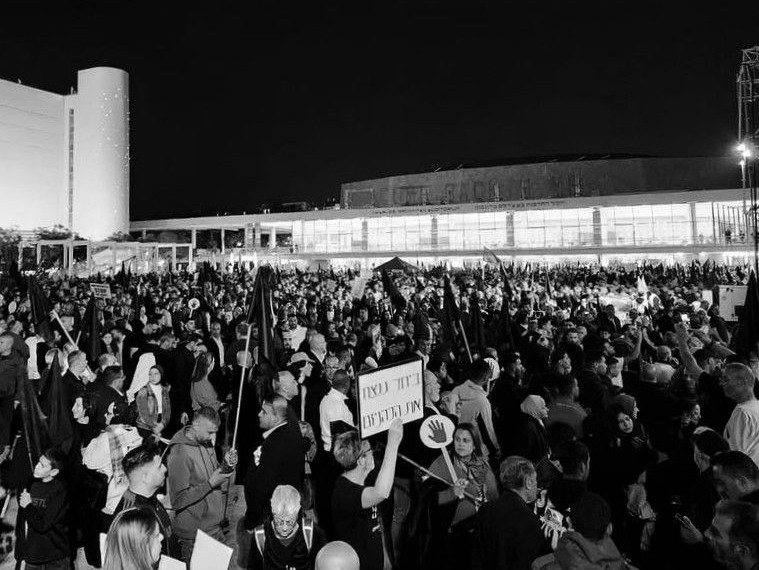
On Saturday night (31.1.26) the enlightened public, Jews and Arabs, made its voice heard in the demonstration held in Tel Aviv.


