
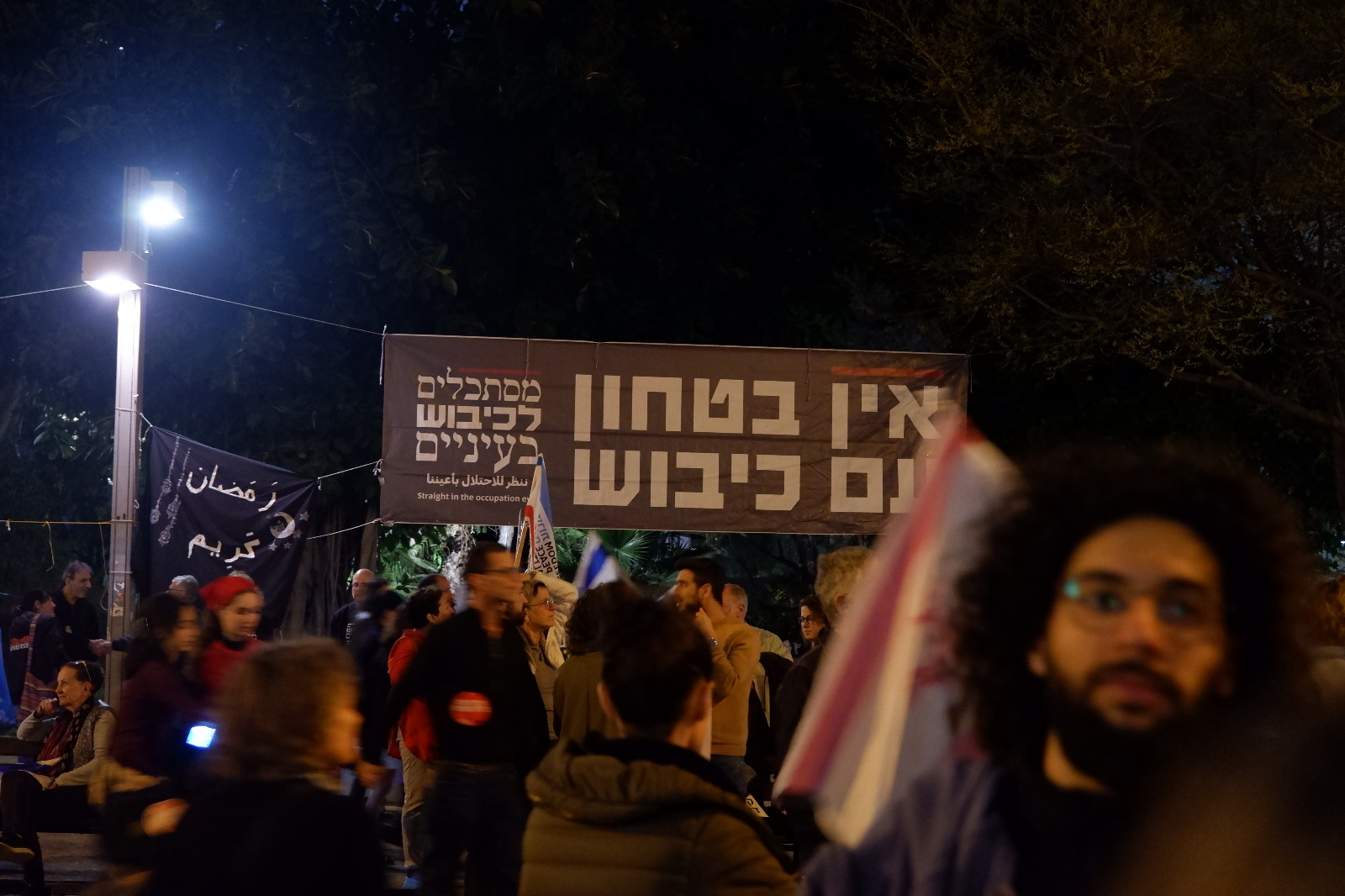


This happens every single week. Activists from “Looking the Occupation in the Eyes” alongside ordinary demonstrators hold up signs saying “Only peace will bring security” or “There is no security with occupation” and there will always be the enlightened protester, the anti-Bibi type, who asks “Right, but who would you make peace with?” And as long as we still have the strength, we answer “With the Palestinians”, and we are immediately answered “You’d give them a state in Judea and Samaria 15 km from the sea?”. And indeed, the overwhelming majority of Israelis today oppose the “two-state idea”, meaning the existence of a Palestinian state west of the Jordan River. In various polls, opposition stands at about 70%, and among Jews the number may reach 80%. Only about 20% of Israel’s Jewish residents want a state to our east that would raise a flag in watermelon colors.
The arguments of the 80% are not baseless. The main claim is that establishing a Palestinian state in the West Bank endangers Israel’s very existence. After all, Judea and Samaria dominate the coastal plain, where Israel’s population centers and strategic infrastructure are located. Even if the intentions of the Palestinian signatories to a peace agreement are pure, there is still fear that the new state will fall into the hands of extremist elements and become a launching pad for terror attacks, possibly even larger ones.
These concerns are not without foundation. The 2005 disengagement from Gaza enabled the establishment of a Hamas state, and the unilateral withdrawal from Lebanon left the door open to Iranian involvement and the creation of Hezbollah’s military wing. The claim is that a Palestinian state would be a repeat of those failures on a more dangerous scale. There is also the claim of practical infeasibility in the current reality. The settlements, the lack of trust between the sides, and internal division both among Palestinians and among Israelis will not allow it.
The reality is that among the Israeli public there are many who reject any possibility of an agreement and compromise with Palestinians on the grounds that “the Palestinians are not only unwilling to make peace they are also unwilling to accept any arrangement in which Jews have a state”. A key hanging around the necks of descendants of the refugees of ’48 is the vivid proof of that. And we still have not mentioned the messianic right, which believes that the land from the sea to the Jordan, and beyond the river, belongs to the chosen people, and only to them.
To complete the picture, it is worth quoting Aryeh Eldad who is representing the deep ideological right. “The main argument against establishing a Palestinian state must not be a security argument…. Not because of the Arabs. Because of ourselves. There is not a single normal group of people in the world willing to give up of its own will the heart of their homeland. No sane people relate to its homeland instrumentally as a ‘safe haven’ and not in a value-based way as a homeland.”
But the State of Israel cannot allow itself that luxury. Einat Wilf, who received a sympathetic interview in Maariv (12.12.25), says she has sobered up since her days as a Knesset member in the Labor and Independence factions under Ehud Barak. She does claim the Palestinians are not willing to accept any arrangement with Israel, but she recognizes that “The State of Israel, certainly as a tiny country in an Arab and Muslim region and as one dependent on the world, needs to clarify that it wants peace and strives for peace under certain conditions instead of saying ‘no’ to every initiative. Only recently the Saudi crown prince said he would be happy to advance the Abraham Accords on condition that a path toward two states will be opened but Israel responds by saying ‘not willing’”. Ultimately, Wilf too reaches the conclusion that it is appropriate to promote peace that comes with costs “on the basis of Arab and Palestinian acceptance of Zionism”.
There were years when a majority of the Israeli public supported territorial compromise and the establishment of two states. In polls conducted by the Israel Democracy Institute and Tel Aviv University in 2007, support among the Jewish public for the two-state solution reached about 70%. Even in the second decade of the millennium, most polls found that support among Jewish Israelis for a two-state solution generally hovered around 50 to 60% or more. The significant decline in support for such a separation agreement occurred after October 7, 2023.
The global and regional reality and Israel’s total dependence on the U.S. are not the only argument in favor of a two-state solution, a solution that would be a painful but necessary historical compromise when, in practice, the Palestinians give up 78% of the land of Palestine between the sea and the Jordan River. In addition, supporters of the two-state solution argue that such a move is necessary to preserve Israel as a democratic state, since continuing to rule over millions of Palestinians in the territories without full civil rights undermines its democratic character.
Ending the conflict and establishing a Palestinian state would neutralize the hostility of Arab states and Muslim countries, enable Israel to exist in the region, create economic prosperity, restore Israel’s international legitimacy, so lacking in these days, and even the worldwide surge of antisemitism would fade.
Netanyahu governments “managed” the conflict and kept Hamas alive in order to sabotage the obvious possibility of a separation solution, while on the other side of the negotiating table sit representatives of the PLO, whose consistent position for years has been that a Palestinian state will be established on the 1967 borders with East Jerusalem as its capital alongside the State of Israel. As early as 1988, the date of the declaration of the Palestinian state, Yasser Arafat declared that the PLO accepts UN Security Council Resolutions 242 and 338, whose meaning is recognition of the State of Israel alongside a Palestinian state in the territories occupied in 1967. This is a stable historic compromise, involving relinquishing the full realization of Palestinian demands. Five years later, in 1993, with the signing of the Oslo Accords, the PLO chairman wrote to Prime Minister Yitzhak Rabin that the organization representing the Palestinian people recognizes the right of the State of Israel to exist in peace and security.
Arafat’s successor, President of the Palestinian Authority Mahmoud Abbas, also consistently supports this position. Among his statements are “We support the two-state solution on the basis of the 1967 borders with East Jerusalem as the capital of the Palestinian state” and “We are not seeking one state and we are not seeking to harm Israel. We want a state of our own alongside the State of Israel.”
Indeed, not all Palestinians hold one uniform position. As in Israel, there is a broad spectrum of views there, some stemming from the interpretation extremists give to their religion. They have Hamas, but we also have our own Hamas. Still, the official Palestinian leadership, the PLO and the Palestinian Authority, has recognized Israel and supported a two-state solution for more than 30 years. True, the PLO’s standing among Palestinians has deteriorated, not least thanks to the Authority’s cooperation with Israel. Those who declare and call for Israel’s destruction do not represent the entire Palestinian people. Another fact should be acknowledged. At present, the Palestinians have nothing to lose, and therefore extremist positions gain popularity, as does support for the atrocities of October 7. When there is a political and economic horizon, and when the vision of a Palestinian state is realized, those voices will diminish at once.
The bottom line is that between the Jordan and the sea live two peoples. Each has an equal right to freedom, security, and self-determination. The existing reality, of prolonged occupation, military control, and violence, harms both peoples and leads to a future of despair that breeds war and terror.
A solution based on mutual recognition, agreed borders, Israeli withdrawal to the 1967 lines with agreed adjustments that end the occupation, an effective and just solution to the Jerusalem issue, compensation, even if symbolic for the refugees of ’48, and building a future of meaningful civic, economic, and regional cooperation, would mean a secure future for both peoples. The dreams of a religious theocratic state, Jewish or Muslim, should be left to prayers.


