

.png)
This week, the High Court of Justice heard a petition filed by residents of Ras Ein al-Auja, who about a year ago sought to prevent their expulsion. The Court ruled that the respondents (the Regional Military Commander, the Civil Administration, and the police) would provide the petitioners with assistance, in advance coordination, to enable their return to their place of residence, focusing on a specific area in Ras Ein al-Auja. This decision, as is known, was issued after the residents had already abandoned their homes, and experience shows that previous, similar court decisions have remained dead letters. No community has been able to return to its home in the absence of will and readiness on the part of the respondents to confront the settlers and those who send them, who sit around the government table.
Sunday – Activists from “Looking the Occupation in the Eye” arrived in Fasayil at the home of Abed in order to manually remove rotten dates that settlers had brought by truck and dumped at the entrance to the house.
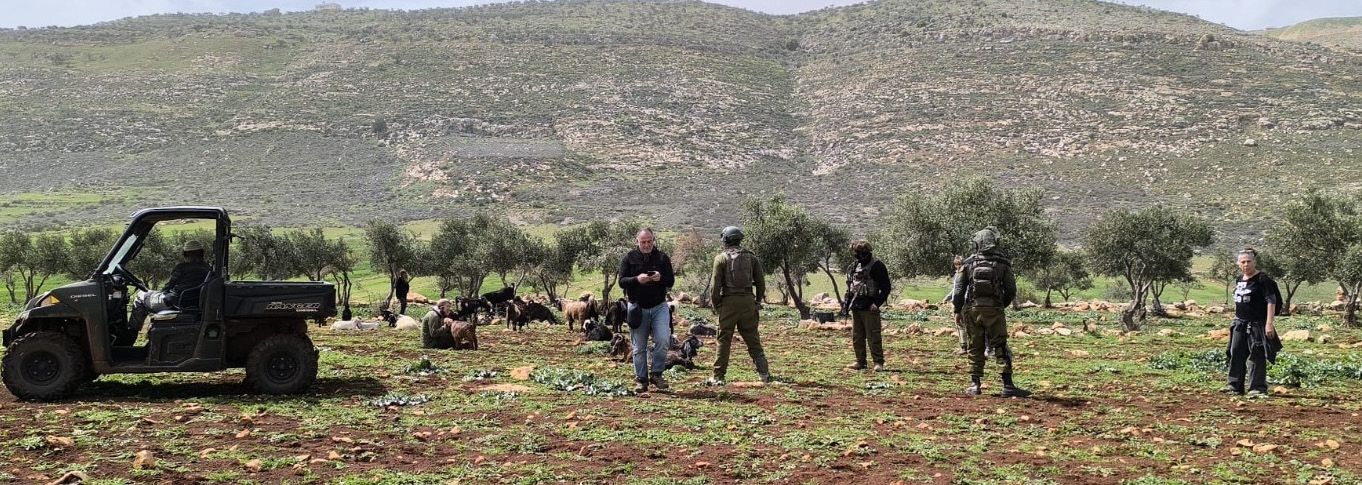
Monday – Activists from “Looking” returned to Abed’s home in Fasayil equipped with tools and wheelbarrows and began clearing the rotten dates. After some time, soldiers arrived at the site and demanded that the activists move away, on unfounded pretexts, claiming they were “stealing dates” and “trespassing on the private land of the nearby outpost.” Hours passed, and then the uniformed personnel summoned the police, who removed the activists under threat of detaining them on the grounds of “interfering with a police officer in the performance of his duties.” The law enforcement representative voiced the same false claims, entirely lacking legal and factual basis and without presenting any document or order, thereby enabling the settlers to return later that day and continue harassing the family.
The High Court hearing on the petition of the residents of Ras Ein al-Auja, filed in March 2025, was held before Justices Solberg, Stein, and Kanfi-Steinitz. The petition, submitted on behalf of the village residents and the organization “Looking the Occupation in the Eye” by attorney Shlomo Leker, was heard after many months and after the residents had abandoned their land, but two weeks ago. In August 2015, the Association for Civil Rights in Israel joined the petition as amicus curiae. The Association argued that the state refrains from protecting the residents—both by omission, through non-enforcement against settler violence, and by commission. During the hearing, the parties presented their arguments.
Tuesday – A herd of cows was led by settlers into Fasayil, with the animals trampling everything in their path near Abed’s home.
Wednesday – The High Court’s decision on the petition of the residents of Ras Ein al-Auja was published. The brief decision stated:
“In the spirit of the practical approach that characterized the arguments of both the petitioners and the respondents, it was decided that the respondents (the Regional Military Commander, the Civil Administration, and the police) will provide the petitioners with assistance, in advance coordination, to enable their return to their place of residence, focusing on a specific area in Ras Ein al-Auja.”
The decision further stated that “an update notice on behalf of the respondents shall be submitted within 60 days, detailing enforcement activities carried out in the area during this period, for the purpose of ensuring security.”
“Looking the Occupation in the Eye” published a response to the decision:
“The Court did well in deciding to place responsibility on the state for returning the village residents to their homes. Throughout the legal proceedings, the state provided false information to the Court, and had it not done so, the grim outcome in which the residents fled their village out of fear of the settlers and the army might have been avoided.”
The statement further said that “the residents’ return will not be possible unless the state now guarantees minimal conditions for the community, including closing the area to Israelis except for community guests, a permanent military or police presence whose task is to protect the residents (as exists in every settlement), and allowing residents to rebuild their homes. Without the state’s willingness to meet these conditions, any decision on the matter will be meaningless.”
Thursday – A herd of cows returned to Fasayil accompanied by a group of young settlers, this time without large skullcaps and without fluttering ritual fringes.
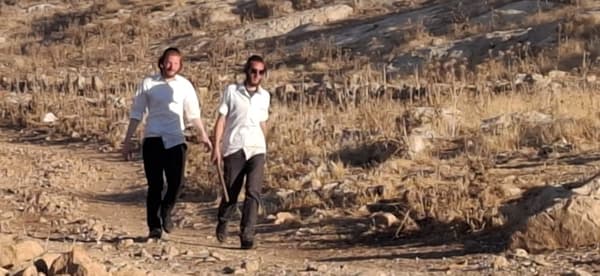
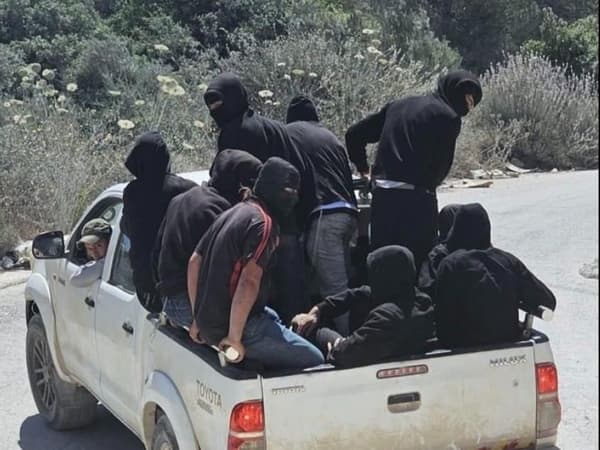
Friday – After settlers had twice, over the preceding two weeks, dumped truckloads of rotten dates at the entrance to a Palestinian family’s home, Eliav Libby from the nearby outpost arrived at the scene together with a group of outpost youths. They invaded the yard of the house and behaved as if it were their own. The police were called to the scene several times, but no patrol car arrived.
Saturday – Settlers, including Eliav Libby and outpost youths, returned to the compound of Abed’s home in Fasayil and threatened to enter the building. Activists from “Looking” managed to stop them. Activists from “Looking the Occupation in the Eye” also assisted with a “protective presence” in Duma and Jiftlik.