


Summary
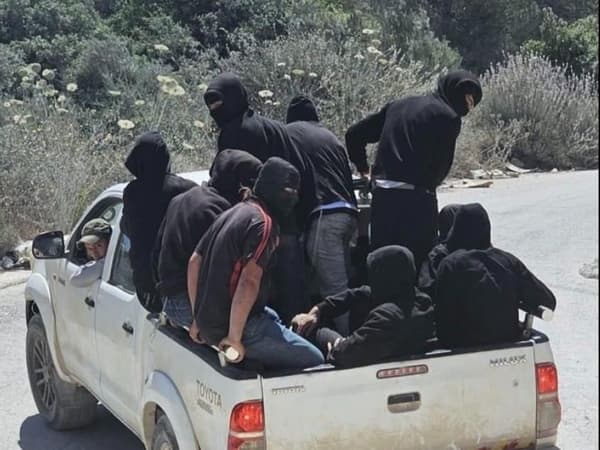
The violence carried out this week by outpost youths, sent by the founders of the outposts to intimidate and threaten the residents of Ras Ein al-Auja, included a range of actions: beating women with a stick and pushing them, a slap delivered by a roughly 16-year-old boy to a man in his seventies, attempts to sabotage water pipes, and daily incursions into residents’ living areas. The security coordinator (ravshatz) of Mevo’ot Jericho, who was present in Ras Ein al-Auja in most incidents where army and police were summoned, once again did nothing this week to prevent the violent outpost youths from acting in their criminal manner.
Monday – Around midday, a herd of camels led by a settler shepherd entered the village and blocked the road at the settlement’s entrance. An activist called the police while the settler threw a stone at the activists. He was busy confronting the activists, and the camels chose to scatter, requiring a long time to gather them.
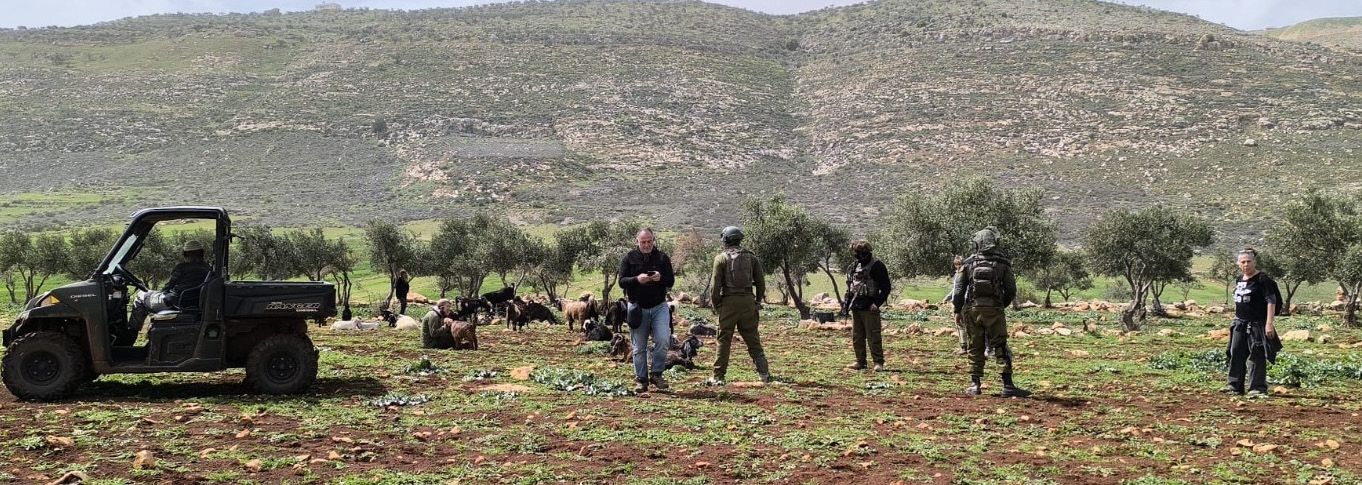
Tuesday – A call to the police following the morning incursion of a herd of goats from the outpost into the Salameh family compound went unanswered. In the second half of the day, the same shepherd returned with the goats to the sheepfold structures belonging to the Salameh families. Activists again called the police; this time the Mevo’ot Jericho security coordinator appeared and stood by the shepherd at some distance from the village homes. When the goat herd moved toward the guest tent (the madafeh), the coordinator drove after it and blocked the activists’ vehicle. An appeal to the police yielded no assistance.
Wednesday – A settler from the outpost, known as “Lev-Tahor,” entered the Salameh family compound with a donkey and a herd. At the same time, Micha Soudai, who manages an outpost neighboring Ras Ein al-Auja, drove along the village’s main road playing a song in Arabic at high volume. The presence of the two settlers prevented Palestinian residents from taking out their flocks and continuing their agricultural work due to fear of the intruders. Near the local school, an activist from “Looking the Occupation in the Eye” stood watch; the settler threatened her with a club he was holding. After a while he lost restraint and struck an activist. Police summoned after the violent incident clarified that “they are allowed to roam anywhere.”
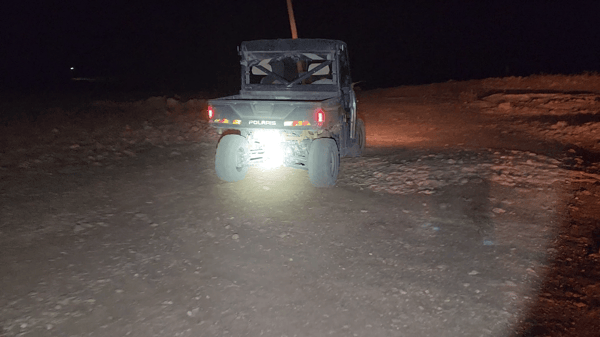
After dark, settlers’ vehicles, including that of the Mevo’ot Jericho security coordinator, drove back and forth along the village roads. During these passes, the drivers engaged in provocations that included stopping and staring at activists for extended periods, using high beams, and making noise.
Thursday – A routine incursion by two outpost youths with their herds into the Salameh homes. One of them, a minor, struck an activist and knocked him down. The Mevo’ot Jericho security coordinator arrived, followed by the police. Unsurprisingly, the person detained for questioning was the beaten activist, along with activists who had been nearby. The violent minor also arrived at the police station; he was invited to give testimony.
In the evening, cars from the outpost and police vehicles crossed the village—some flashing high beams, others stopping to watch the guest tent. Later that night, four Hilltop Youths, one riding a horse, harassed the Naif family, shone high beams on their home, and intimidated residents by their presence.
Friday – The Mevo’ot Jericho security coordinator roamed the village between the school and the Naif family area, accompanied by Hilltop Youths in a Ranger vehicle. The minor who had entered the Abu Taleb family compound with a herd tied his donkey to the fence and attacked an activist. The police were notified. An officer who arrived repeated the familiar claims: “This land belongs to no one; they are allowed to be here.” Even a land registry (tabu) document presented to him did not convince him that this was an intrusion into residents’ property.
Saturday – Settler activity throughout Ras Ein al-Auja began at 7:00 a.m., when the Mevo’ot Jericho security coordinator entered the village with his vehicle. Shortly thereafter, herds of camels and goats arrived from the outpost toward the Salameh family area. The coordinator joined the intruders, taunted the activists, and—after satisfying himself—drove off to block the passage of activists’ vehicles at the end of the road leading to the Salameh homes. After some time, the camel herd advanced toward the Abu Taleb compound. Avishai Horowitz, a dominant settler, arrived for a visit with his wife and then joined Lev-Tahor, the shepherd standing near the homes and the activists.
Toward noon, Avishai Horowitz and three settlers returned to Ras Ein al-Auja with the Ranger vehicle, stopping at the guest tent and then driving toward Kokhav HaShahar. They were replaced by another group that also arrived in a Ranger vehicle. The vehicle’s passengers approached the guest tent and the buildings where residents and human rights activists were present.
In the afternoon, there was another incursion with a herd led by two violent minors together with Lev-Tahor. The camel herd entered the courtyards of homes and chewed on tree branches there. The Mevo’ot Jericho security coordinator joined the settlers with the invading herds, documented the activists, and did not prevent the minors from pressing up against the activity areas and the courtyard and sheepfold fences.